Anthropic reports early Claude drug development results; acquired one-person biotech Mithril Medicine
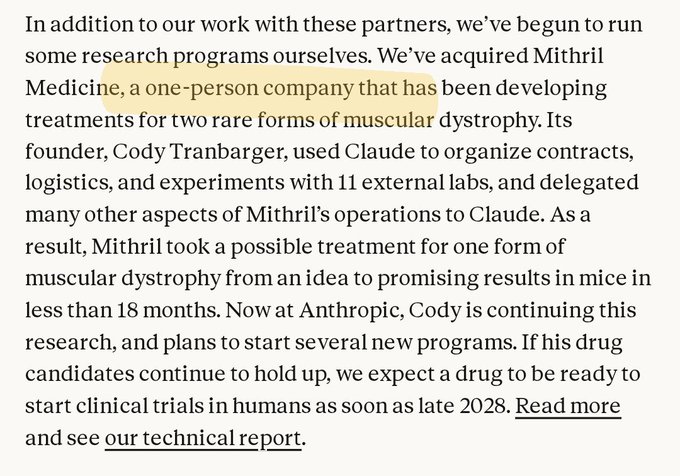
Anthropic announces early results from research partnerships with six drug development organizations, including BigHat Biosciences, Bristol Myers Squibb, and Generate Biomedicines, plus its own drug discovery programs such as rare childhood muscular dystrophy. Since the announcement, Andrew Curran and the Mithril founder revealed Anthropic acquired Mithril Medicine, whose founder used Claude to take a muscular dystrophy antibody treatment from concept to proof-of-principle in mice in 18 months. No safety analysis appears in the posts so far.
All posts · 7, most important first
- Over the past few months, Anthropic scientists have engaged in deep research partnerships with six organizations developing new medicines. We've also begun drug discovery efforts of our own. In doing so, we’ve learned much more about how Claude can support the many stages of drug development. In this blog post, we share some early results from these efforts, and describe how this work fits in with our wider ambitions in the life sciences. anthropic.com/research/early…172 likes · 21 reposts
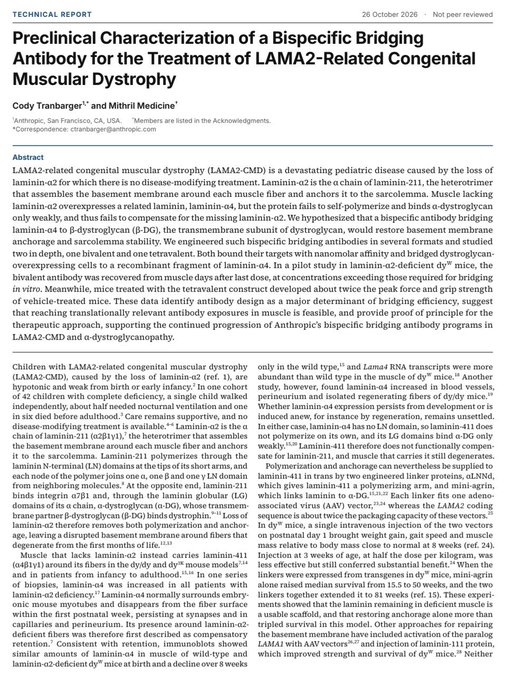
- Sam Altman's one-person company prediction is coming true. Anthropic just bought one. The founder of Mithril Medicine used Claude to take a muscular dystrophy antibody treatment from concept to proof-of-principle in mice in 18 months, with just himself, Claude, and part-time consultants. The technical report is great. I will quote: 'The week opened with the handover of two cell-based assays, cell adhesion and flow cytometry, within our team, while eleven questions remained open with the assay CRO. In two sentences, one of us asked Claude to review the latest emails between the outgoing assay lead and the assay CRO and to recommend next steps for the handover, and gave it the link to the handover folder. Claude returned a bottom line after 96s and a full plan with five drafted emails after 18 min. For the full plan it read six email threads, the handover folder, two slide decks and two reports, all in the mailbox and file store to which we had given it access. Four working days later, nine of the eleven questions had an answer in writing and the other two had been left to pilot experiments. The adhesion screen was thereby set out in writing. The CRO drew the plate map to the format that our team had requested, Claude compiled the run order and the material calculation from the production data, and one of us reviewed and approved them. On day 4, the production CRO delivered its data package, a report of 341 pages, which one of us forwarded to Claude in two sentences, with the request to review it, share observations and recommend next steps. Claude returned a bottom line after 2 min 40s and, once it had read every page, a visual synthesis of all 113 constructs after 7 min 53s. The synthesis arranged the constructs on the grid of 14 by 8 arms. Claude marked 82 constructs for screening as is, seven for additional polishing, and the 24 constructs of three laminin-binding arms to be held back from the cell-based assays on production criteria. Each of the 113 constructs thus had a proposed next step in less than 8 min. Claude had recommended binding kinetics for all 113 con-structs, and on day 7 one of us challenged this plan. Claude defended it within 27s, arguing that affinity would show whether the three arms merit further work. One of us overruled this recommendation and set the three arms aside on production criteria. Their material remains in storage. Four minutes later, Claude had revised its memo, the working page, the run order and three unsent drafts from 113 to 89 constructs. It had also applied the ruling to three dependent steps in the unsent drafts, each flagged for our veto. The exchange took 7 min 36s from challenge to new plan, and every affected email was still an unsent draft. After the ruling, eight emails drafted by Claude went out on the same day to three CROs and a consultant. Over the whole week, Claude drafted 17 emails, each in answer to a request from one of us, and we sent 12 of them, each after editing. With its drafts, Claude listed 41 points, such as tube fills, shipping conditions, recipients and assay settings, for which it had found no written statement of ours, so that we could confirm, change or strike each before sending. We kept some, struck others and changed one. Among the passages that we kept were proposals for controls. One draft proposed a comparison of polished and unpolished material on one sensor chip, to size the error that impurities cause in the rest of the panel. Another requested a buffer control diluted like the most dilute sample, so that any effect of the buffer appears at its largest. These proposals concerned the measurement of constructs that had already been produced, and each reached a CRO only after one of us had reviewed and approved it.
 @andrewcurran_: Dr Mythos is on the job. open on X114 likes · 13 reposts
- Founder reveal!Surprise 1: Anthropic acquired a one-person biotech . . . Surprise 2: that person is me Surprise 3: I’m here to tell you all about it Yes, this is what you think it is; after 6 yrs of increasingly loose anonymity: the Professor Oak reveal post …and yes, it has gotten so boring around here that I’m literally doxxing myself to spice up the timeline ------- Ok, allow me to introduce myself. My name is Cody Tranbarger. I mostly tweet, but occasionally find time to dabble in drug dev & starting/building biotechs. My past lives span the VC, crossover, startup continuum; Prof Oak has been my way of keeping a digital foot in those worlds, despite having my physical feet planted elsewhere. The past 18 mo, ‘elsewhere’ was Mithril Medicine, a co. I founded to develop bsAbs for LAMA2-CMD & other ECM-related genetic diseases. Mithril was born out of hands-on building with @MikeNGladstone, @JasonPaulRhodes, @LifeSciVC, & team @atlasventure. Somehow, I made enough half-decent calls along the way (even a broken clock is right twice a day, eh?) to convince them Mithril/I warranted a small seed. While I can hardly rationalize such an outrageously cavalier bet, I’m grateful for it, & I'd partner with Atlas again in a heartbeat. In typical AV fashion, Mithril’s primordial form was virtual, decentralized, & ultra-lean. This stage tends to be short-lived, but for Mithril, it worked surprisingly well, for surprisingly long, thanks in part to the rapid maturation of the AI tools I used liberally. Eventually, Mithril became a bit of an experiment itself - to find the upper bound of how far it could scale as a single operator + a bunch of Claude (+ a stellar bench of part-time consultants). In parallel, I started spending time with @nc_frey, @an1lam, & @CoefficientBio team; and promptly experienced, for the 1st time, AI at the frontier. Soon thereafter, Mithril stopped looking like an experiment, & started looking like a preview of an entirely new operating model. From that spark came “Pipeline-in-a-Person.” The idea immediately resonated when we shared it here back in April; and it was central to the shared vision that led to Anthropic’s acquisition of Mithril, & my joining the team. Why join Anthropic? Three reasons. (1) For Mithril, the programs continue, with more resources & infrastructure behind them, and as much Claude as I can put to work. (2) For me, the chance to start several more programs, & find out how many one person can actually run in parallel - an almost unprecedented luxury for a curious drug hunter. (3) For our mission, a path to institutionalize & scale this new way of working, then put it in the hands of all of biopharma, all over the world - which, candidly, I find the most energizing. Will AI x Bio cure diseases? Unequivocally yes, imo… but not by the route that gets the most airtime. Rather than timeline acceleration & compression, I see orchestration & parallelization as today's low-hanging fruit. Most drug hunters see a handful of go/no-go calls in a career, & spend entirely too much of the rest trading emails (my inbox can attest). Give them the bandwidth to run several programs at once, and the time to focus on scientific judgment, and I’m willing to bet they’ll make better calls. And at scale, better calls translate to more drugs, higher hit rates, broader patient impact, & likely, a disease or 10 or 100 cured. I couldn't be more excited to build toward that future @AnthropicAI. Finally, a heartfelt thank you to BioTwitter/X. The end of anonymity is bittersweet, but if anyone’s earned a proper introduction, you all have. It’s difficult to overstate how much this app has done for me: a decade of education, plenty of friends, many job opportunities, several mentors, a few investors, even a co-founder (fmr). It was the generosity of this community that inspired me to start posting 6 years ago, after just as many years lurking. I hope I’ve been able to pay it forward, in my own small way. But, to be clear, Prof Oak isn’t going anywhere. Same beat, same themes, and now, a front-row seat to drug development at the frontier. Stay tuned for dispatches from the trenches; and remember... Gotta Cure 'Em All open on X3 likes · 1 reposts
- 'Claude performed the work that grows with the size of a panel, namely reading, calculation, drafting and tracing a decision through every dependent step. The judgments remained with us, and one ruling on three arms decided 24 constructs. This division of labor suggests that the size of a screen need not be limited by the size of the team that directs it.' Quoting from Anthropic: 'Mithril Medicine is developing treatments for two rare and particularly aggressive forms of muscular dystrophy: LAMA2-related congenital muscular dystrophy and α-dystroglycanopathy. Before it was acquired by Anthropic in July, Mithril had only one full-time employee: its founder, Cody Tranbarger. The rest of the work was done by part-time consultants and third-party labs. But Cody found that the team’s progress was often held back by the logistical burdens of scientific research, including coordinating vendors, analyzing data, and planning next steps. He began using Claude extensively to ease those bottlenecks. By offloading much of the company’s operational tasks to Claude, Mithril was able to develop a proof-of-principle for an antibody treatment targeting LAMA2-CMD in less than 18 months. In their short-term study, mice with a severe form of the disease that received the antibody therapy had roughly twice the grip strength and tricep force of untreated mice, and more of them survived to the end of the study. Mithril’s work on these two diseases became Anthropic’s first in-house drug development programs. It’s also been Anthropic’s first experiment with this “Pipeline-in-a-Person” research model, in which one scientist works with Claude to pursue several biological hypotheses at the same time. Cody still runs both of Mithril’s original research programs, and is preparing to start several more. Beyond Mithril, turning the first idea for a new drug program into a detailed thesis, design plan and experimental strategy took two to three days. Cody estimates that, without Claude, it would have taken him one to two months.'4 likes · 0 reposts
 1 likes · 0 reposts
- Dr Mythos is on the job.
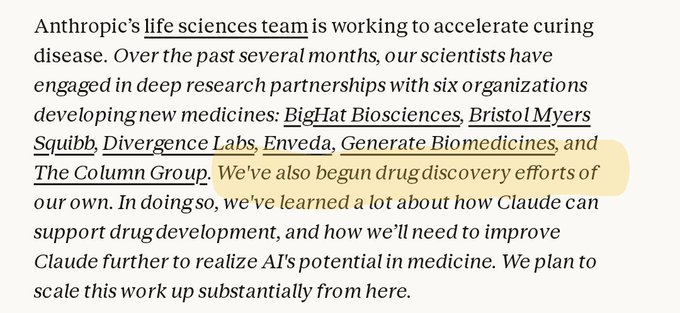 @anthropicai: Over the past few months, Anthropic scientists have engaged in deep research partnerships with six organizations developing new medicines. We've also begun drug discovery efforts of our own. In doing so, we’ve learned much more about how Claude can support the many stages of drug development. In this blog post, we share some early results from these efforts, and describe how this work fits in with our wider ambitions in the life sciences. anthropic.com/research/early… open on X235 likes · 13 reposts
- I was writing my longform:@andrewcurran_: Sam Altman's one-person company prediction is coming true. Anthropic just bought one. The founder of Mithril Medicine used Claude to take a muscular dystrophy antibody treatment from concept to proof-of-principle in mice in 18 months, with just himself, Claude, and part-time consultants. The technical report is great. I will quote: 'The week opened with the handover of two cell-based assays, cell adhesion and flow cytometry, within our team, while eleven questions remained open with the assay CRO. In two sentences, one of us asked Claude to review the latest emails between the outgoing assay lead and the assay CRO and to recommend next steps for the handover, and gave it the link to the handover folder. Claude returned a bottom line after 96s and a full plan with five drafted emails after 18 min. For the full plan it read six email threads, the handover folder, two slide decks and two reports, all in the mailbox and file store to which we had given it access. Four working days later, nine of the eleven questions had an answer in writing and the other two had been left to pilot experiments. The adhesion screen was thereby set out in writing. The CRO drew the plate map to the format that our team had requested, Claude compiled the run order and the material calculation from the production data, and one of us reviewed and approved them. On day 4, the production CRO delivered its data package, a report of 341 pages, which one of us forwarded to Claude in two sentences, with the request to review it, share observations and recommend next steps. Claude returned a bottom line after 2 min 40s and, once it had read every page, a visual synthesis of all 113 constructs after 7 min 53s. The synthesis arranged the constructs on the grid of 14 by 8 arms. Claude marked 82 constructs for screening as is, seven for additional polishing, and the 24 constructs of three laminin-binding arms to be held back from the cell-based assays on production criteria. Each of the 113 constructs thus had a proposed next step in less than 8 min. Claude had recommended binding kinetics for all 113 con-structs, and on day 7 one of us challenged this plan. Claude defended it within 27s, arguing that affinity would show whether the three arms merit further work. One of us overruled this recommendation and set the three arms aside on production criteria. Their material remains in storage. Four minutes later, Claude had revised its memo, the working page, the run order and three unsent drafts from 113 to 89 constructs. It had also applied the ruling to three dependent steps in the unsent drafts, each flagged for our veto. The exchange took 7 min 36s from challenge to new plan, and every affected email was still an unsent draft. After the ruling, eight emails drafted by Claude went out on the same day to three CROs and a consultant. Over the whole week, Claude drafted 17 emails, each in answer to a request from one of us, and we sent 12 of them, each after editing. With its drafts, Claude listed 41 points, such as tube fills, shipping conditions, recipients and assay settings, for which it had found no written statement of ours, so that we could confirm, change or strike each before sending. We kept some, struck others and changed one. Among the passages that we kept were proposals for controls. One draft proposed a comparison of polished and unpolished material on one sensor chip, to size the error that impurities cause in the rest of the panel. Another requested a buffer control diluted like the most dilute sample, so that any effect of the buffer appears at its largest. These proposals concerned the measurement of constructs that had already been produced, and each reached a CRO only after one of us had reviewed and approved it. open on X1 likes · 0 reposts
 @anthropicai org ·
 @andrewcurran_ commentary ·