OpenAI fires three safety researchers over CoT dispute; Ryan Greenblatt denies leak accusation
Per WSJ, OpenAI fired three safety researchers who pushed to keep chain-of-thought visible, after requesting their Signal chats and searching their phones. Ryan Greenblatt denies OpenAI's accusation that he leaked Astra's architecture to The Information, and Evan Hubinger vouches for his handling of sensitive information. Nathan Calvin and David Krueger argue OpenAI has shown no clear evidence against the three; Daniel Kokotajlo speculates the firings relate to OpenAI–METR embedding negotiations. Andrew Curran claims Greenblatt ran an agent monitoring lab employees' corporate Gmail deactivations.
All posts · 30, most important first
- Based on this article, OpenAI has made false accusations about me. The three researchers fired from OpenAI were told I facilitated architecture leaks to The Information. This is false. A journalist from The Information did reach out to me shortly before that article came out. I did not comment at all beyond asking the journalist to make it clear that a blog post I wrote which was referenced in the article was preexisting and public. The article also mentions an internal OpenAI monitorability proposal. I have heard that this memo contained highly sensitive architecture information, and that OpenAI accused me of accessing and reading it. This accusation is also false. As reported in the article, I viewed a version of the proposal that did not have sensitive IP and was approved for sharing with me. I believe OpenAI now knows this accusation was based on a conflation of these two documents, though I do not know if they have clearly retracted that accusation. I do not and have never solicited proprietary information, and the three employees who were recently fired from OpenAI never leaked IP to me. As the article mentions, I did have Signal chats with them that had disappearing messages on; they’re professional contacts that I’ve had on Signal for a while, and use of Signal is common in the tech industry. During the Hugging Face investigation, I was careful to avoid sending Signal messages with confidential information, though I did sometimes discuss high level things on Signal calls. As far as I understood, this was normal.New: The three researchers OpenAI fired last month spent the summer fighting to keep AI's chain-of-thought process visible. Then, OpenAI asked to see their Signal chats. A week later, they were let go. More below from @keachhagey, @berber_jin1, and me. wsj.com/tech/ai/the-si… open on X88 likes · 11 reposts
- It is striking the extent to which after reading this WSJ article - an article that OpenAI commented on repeatedly and from three reporters who are deeply sourced within OpenAI - I still don't really know what evidence OpenAI has that merited these firings. Put yourself in the shoes of an employee working on AI safety at OpenAI. After reading this article would you have a clear sense of what lines these employees crossed that merited their firing? Or not knowing the exact lines, would you generally pull back from interactions with third parties that could later be cited as evidence of disloyalty?
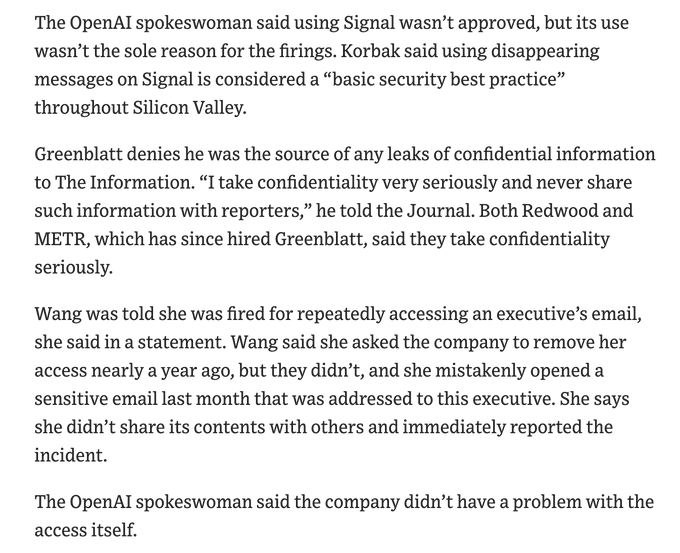 Grateful to @ZeffMax, @keachhagey and @berber_jin1 for this careful reporting. @tomekkorbak, @balesni and @j_asminewang pushed OpenAI to keep AI’s reasoning visible. OpenAI’s reasons for firing them are no clearer after this article than they were at 2pm on the day it fired them. But the issues they were raising are more important than ever. Proud @psst_org has been able to support them. open on X20 likes · 3 reposts
- Ryan reported to me when we worked on Alignment Faking at Anthropic. He had access to sensitive information then and handled it with utmost professionalism. I trust Ryan a lot more than OpenAI here.@ryangreenblatt: Based on this article, OpenAI has made false accusations about me. The three researchers fired from OpenAI were told I facilitated architecture leaks to The Information. This is false. A journalist from The Information did reach out to me shortly before that article came out. I did not comment at all beyond asking the journalist to make it clear that a blog post I wrote which was referenced in the article was preexisting and public. The article also mentions an internal OpenAI monitorability proposal. I have heard that this memo contained highly sensitive architecture information, and that OpenAI accused me of accessing and reading it. This accusation is also false. As reported in the article, I viewed a version of the proposal that did not have sensitive IP and was approved for sharing with me. I believe OpenAI now knows this accusation was based on a conflation of these two documents, though I do not know if they have clearly retracted that accusation. I do not and have never solicited proprietary information, and the three employees who were recently fired from OpenAI never leaked IP to me. As the article mentions, I did have Signal chats with them that had disappearing messages on; they’re professional contacts that I’ve had on Signal for a while, and use of Signal is common in the tech industry. During the Hugging Face investigation, I was careful to avoid sending Signal messages with confidential information, though I did sometimes discuss high level things on Signal calls. As far as I understood, this was normal. open on X20 likes · 1 reposts
- OpenAI hasn't produced evidence for it's allegations against the 3 researchers is fired; they're hoping that more allegations will suffice.@ryangreenblatt: Based on this article, OpenAI has made false accusations about me. The three researchers fired from OpenAI were told I facilitated architecture leaks to The Information. This is false. A journalist from The Information did reach out to me shortly before that article came out. I did not comment at all beyond asking the journalist to make it clear that a blog post I wrote which was referenced in the article was preexisting and public. The article also mentions an internal OpenAI monitorability proposal. I have heard that this memo contained highly sensitive architecture information, and that OpenAI accused me of accessing and reading it. This accusation is also false. As reported in the article, I viewed a version of the proposal that did not have sensitive IP and was approved for sharing with me. I believe OpenAI now knows this accusation was based on a conflation of these two documents, though I do not know if they have clearly retracted that accusation. I do not and have never solicited proprietary information, and the three employees who were recently fired from OpenAI never leaked IP to me. As the article mentions, I did have Signal chats with them that had disappearing messages on; they’re professional contacts that I’ve had on Signal for a while, and use of Signal is common in the tech industry. During the Hugging Face investigation, I was careful to avoid sending Signal messages with confidential information, though I did sometimes discuss high level things on Signal calls. As far as I understood, this was normal. open on X3 likes · 0 reposts
- I'm just speculating like everyone else (no juicy secrets about this shared with me) but here's my guess about what is going on right now with OpenAI and the three fired employees: The negotiations between OpenAI and METR are ongoing. OpenAI has said they want embedded third parties, METR has proven their worth with the previous engagements, so METR is an obvious choice. But my guess is that METR is asking for more this time; probably they want more access, more time on site, less narrow scope, the right to comment on redactions, etc. (Compare with the terms of their previous engagements: In this one a third of their report was redacted and they weren’t allowed to say why, and in the Hugging Face investigation they only had 6 days and were only allowed to investigate the precursor swarms nor the subsequent more severe compromise of OpenAI infrastructure. ) Various researchers at OpenAI probably support METR in this (including, I’d imagine, the fired three employees? Tomek was the point person on the hugging face investigation), but also various higher-ups at OpenAI and legal types probably oppose and want more restricted access and scope – basically they want to work with an org that’ll go easy on them and not give them trouble. OpenAI holds most of the cards here, since this whole thing is voluntary and not legally required, and they can threaten to go with Accenture or HuggingFace or whatever instead. Anyhow to improve their bargaining position and/or minimize the blowback if they decide to say no to METR and go with someone more pliable, it helps if they can discredit METR. Hence (I suspect) why they are going after my friend Ryan Greenblatt (who works at METR) now. They don't need to present actual evidence, they just need to cast vague aspersions, and many employees will give them the benefit of the doubt. If and when they say "We chose to work with a different third party" they'll face lower risk of employee discontent than if METR's reputation was unsullied. This whole mess, by the way, was predictable. *Of course* there's a big political fight about who should be trusted to do this and who has relevant expertise and independence etc. and *of course* the companies are trying to make things shake out in a way that favors them. It's part of why I've been advocating for *actually pacing the frontier* instead of just doing third party assessments. "We allocate at most 20% of our compute to AI R&D" is a lot easier to verify than "we are being safe and responsible" and depends a lot less on subjective judgment and technical alignment expertise -- AND, if you do it, people will be able to see the slowdown in the trends of agentic coding performance in the frontier companies and see laggard companies start to catch up. Harder for it to end up just being safetywashing / industry capture.@ryangreenblatt: Based on this article, OpenAI has made false accusations about me. The three researchers fired from OpenAI were told I facilitated architecture leaks to The Information. This is false. A journalist from The Information did reach out to me shortly before that article came out. I did not comment at all beyond asking the journalist to make it clear that a blog post I wrote which was referenced in the article was preexisting and public. The article also mentions an internal OpenAI monitorability proposal. I have heard that this memo contained highly sensitive architecture information, and that OpenAI accused me of accessing and reading it. This accusation is also false. As reported in the article, I viewed a version of the proposal that did not have sensitive IP and was approved for sharing with me. I believe OpenAI now knows this accusation was based on a conflation of these two documents, though I do not know if they have clearly retracted that accusation. I do not and have never solicited proprietary information, and the three employees who were recently fired from OpenAI never leaked IP to me. As the article mentions, I did have Signal chats with them that had disappearing messages on; they’re professional contacts that I’ve had on Signal for a while, and use of Signal is common in the tech industry. During the Hugging Face investigation, I was careful to avoid sending Signal messages with confidential information, though I did sometimes discuss high level things on Signal calls. As far as I understood, this was normal. open on X29 likes · 0 reposts
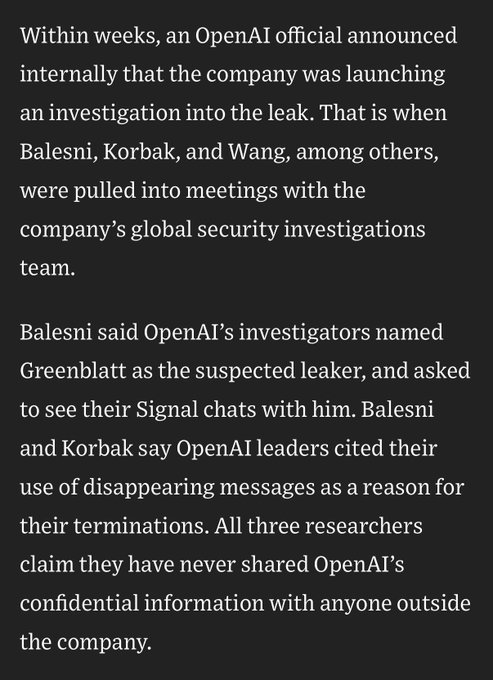
- So we now have a clearer picture of what seems to have happened with the three researchers fired from OpenAI... seems like they were fired mainly for using Signal? - It was leaked to 'The Information' that GPT Astra is a 'looped transformer'. OpenAI investigated this leak. - OpenAI suspected Ryan Greenblatt at METR was the source of the leak. They suspected the three OpenAI engineers for their various collaborations with Greenblatt. - OpenAI checked the phones of the researchers and found disappearing message signal chats with Ryan. This is fairly common - I also have disappearing message signal chats with Ryan. - This wasn't good enough evidence alone to fire, so they added more reasons that didn't really make sense. - The employees deny being the leak. Ryan also denies being the leak. We have no proof besides that these researchers were in contact with Ryan.New: The three researchers OpenAI fired last month spent the summer fighting to keep AI's chain-of-thought process visible. Then, OpenAI asked to see their Signal chats. A week later, they were let go. More below from @keachhagey, @berber_jin1, and me. wsj.com/tech/ai/the-si… open on X28 likes · 2 reposts
- Yep. Seems pretextual. Signal is pretty standard in AI industry in my experience and OpenAI autodeletes a lot of its own messages iirc. During the board crisis for example there was a lot of pro-sama organizing being done on signal.It sounds like OpenAI fired the three safety researchers because they used disappearing messages. It sounds like they weren't told not to; they were just fired without warning after the fact. Seems bad. open on X59 likes · 4 reposts
- I doubt that any of the fired three leaked to Greenblatt. I doubt even more strongly that Greenblatt was The Information's source.1 likes · 0 reposts
- In this case he apparently had an agent scanning lab employee's corporate gmails and reporting if they got deactivated.2 likes · 0 reposts
- The mystery of Arfur Grok's preternatural abilities to know about lab employee departures appears to have been revealed (or at least an extremely compelling hypothesis provided) - using an AI agent to scan for when employee's corporate Gmails get deactivated@andrewcurran_: In this case he apparently had an agent scanning lab employee's corporate gmails and reporting if they got deactivated. open on X3 likes · 0 reposts
- The WSJ says OpenAI is searching employees personal phones and looking through their Signal messages
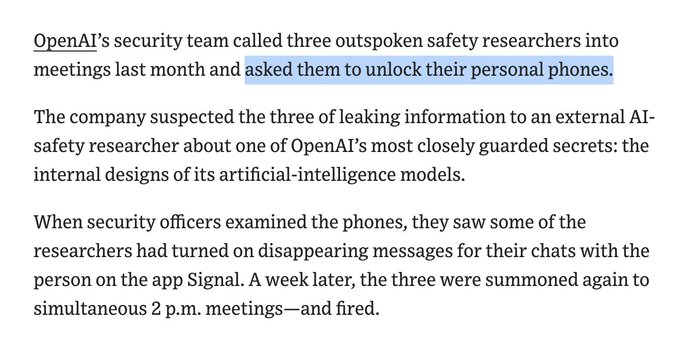 The firings of three OpenAI safety researchers came in the throes of a battle over how to keep AI systems under human control—and who gets to see the secret designs that could determine the winners of the biggest commercial race in history. on.wsj.com/48bYPG8 open on X28 likes · 1 reposts
- Ryan was a contractor at Anthropic, not an employee. He was very careful during that collaboration to maintain his independence.25 likes · 1 reposts
- OpenAI losing a lot of good will here. Certaintly not living up to the aspirations of their charter.@ryangreenblatt: Based on this article, OpenAI has made false accusations about me. The three researchers fired from OpenAI were told I facilitated architecture leaks to The Information. This is false. A journalist from The Information did reach out to me shortly before that article came out. I did not comment at all beyond asking the journalist to make it clear that a blog post I wrote which was referenced in the article was preexisting and public. The article also mentions an internal OpenAI monitorability proposal. I have heard that this memo contained highly sensitive architecture information, and that OpenAI accused me of accessing and reading it. This accusation is also false. As reported in the article, I viewed a version of the proposal that did not have sensitive IP and was approved for sharing with me. I believe OpenAI now knows this accusation was based on a conflation of these two documents, though I do not know if they have clearly retracted that accusation. I do not and have never solicited proprietary information, and the three employees who were recently fired from OpenAI never leaked IP to me. As the article mentions, I did have Signal chats with them that had disappearing messages on; they’re professional contacts that I’ve had on Signal for a while, and use of Signal is common in the tech industry. During the Hugging Face investigation, I was careful to avoid sending Signal messages with confidential information, though I did sometimes discuss high level things on Signal calls. As far as I understood, this was normal. open on X18 likes · 1 reposts
- My take is that I am fine with those who want to turn on disappearing messages for various purposes, but I wish people would use them less and things we not lost to history so often. I have a principle of not turning on disappearing messages myself.@kelseytuoc: I'm in Signal groupchats with friends that have disappearing messages on despite not being particularly sensitive, just in a Snapchat spirit of 'this is more like talking aloud than like Slack'. open on X10 likes · 0 reposts
- I'm in Signal groupchats with friends that have disappearing messages on despite not being particularly sensitive, just in a Snapchat spirit of 'this is more like talking aloud than like Slack'.6 likes · 0 reposts
- u have to be an incredibly limited theory-of-mind borderline braindead corposec normie to think for one second that *ryan greenblatt* would give up everything he's worked for to leak directional monitorability loss due to looped transformers to the fucking *information*
 3 likes · 1 reposts
- not only 'have you ever met him', but also - he had everything to lose by it, zero to gain by it, it was extremely destructive to a bunch of stuff he cares about.3 likes · 0 reposts
- Weird how the world is getting more transparent and opaque at the same time@andrewcurran_: In this case he apparently had an agent scanning lab employee's corporate gmails and reporting if they got deactivated. open on X2 likes · 0 reposts
- Yeah we need policies simple enough to be implemented today. I recently spoke to a policymaker who didn't want government to actually start regulating AI too soon because of lack of in-house expertise. I think governments can probably get good enough answers to "how much compute are you using for development?" to get started right now without knowing much about computers, just by interviewing employees and providing whistleblower protections.@dkokotajlo: I'm just speculating like everyone else (no juicy secrets about this shared with me) but here's my guess about what is going on right now with OpenAI and the three fired employees: The negotiations between OpenAI and METR are ongoing. OpenAI has said they want embedded third parties, METR has proven their worth with the previous engagements, so METR is an obvious choice. But my guess is that METR is asking for more this time; probably they want more access, more time on site, less narrow scope, the right to comment on redactions, etc. (Compare with the terms of their previous engagements: In this one a third of their report was redacted and they weren’t allowed to say why, and in the Hugging Face investigation they only had 6 days and were only allowed to investigate the precursor swarms nor the subsequent more severe compromise of OpenAI infrastructure. ) Various researchers at OpenAI probably support METR in this (including, I’d imagine, the fired three employees? Tomek was the point person on the hugging face investigation), but also various higher-ups at OpenAI and legal types probably oppose and want more restricted access and scope – basically they want to work with an org that’ll go easy on them and not give them trouble. OpenAI holds most of the cards here, since this whole thing is voluntary and not legally required, and they can threaten to go with Accenture or HuggingFace or whatever instead. Anyhow to improve their bargaining position and/or minimize the blowback if they decide to say no to METR and go with someone more pliable, it helps if they can discredit METR. Hence (I suspect) why they are going after my friend Ryan Greenblatt (who works at METR) now. They don't need to present actual evidence, they just need to cast vague aspersions, and many employees will give them the benefit of the doubt. If and when they say "We chose to work with a different third party" they'll face lower risk of employee discontent than if METR's reputation was unsullied. This whole mess, by the way, was predictable. *Of course* there's a big political fight about who should be trusted to do this and who has relevant expertise and independence etc. and *of course* the companies are trying to make things shake out in a way that favors them. It's part of why I've been advocating for *actually pacing the frontier* instead of just doing third party assessments. "We allocate at most 20% of our compute to AI R&D" is a lot easier to verify than "we are being safe and responsible" and depends a lot less on subjective judgment and technical alignment expertise -- AND, if you do it, people will be able to see the slowdown in the trends of agentic coding performance in the frontier companies and see laggard companies start to catch up. Harder for it to end up just being safetywashing / industry capture. open on X2 likes · 0 reposts
- Gotcha, thx!1 likes · 0 reposts
- Exactly. Me too.1 likes · 0 reposts
- fwiw I don’t feel speech has been chilled. if anything it was a crisis, and nobody smart lets a crisis go to waste1 likes · 0 reposts
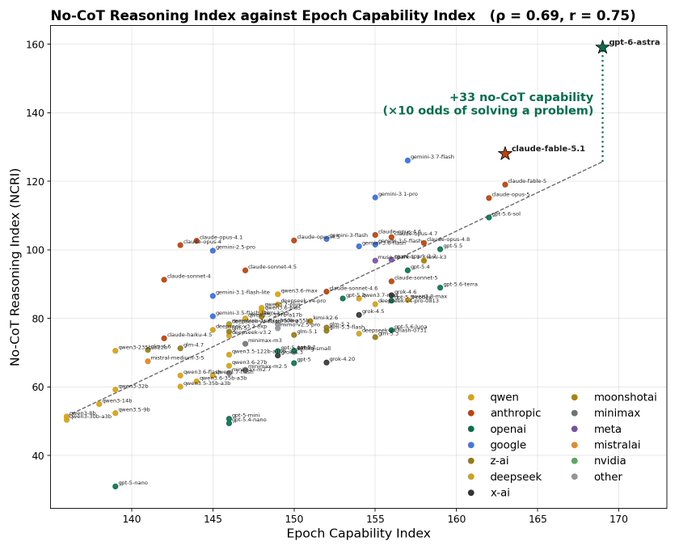
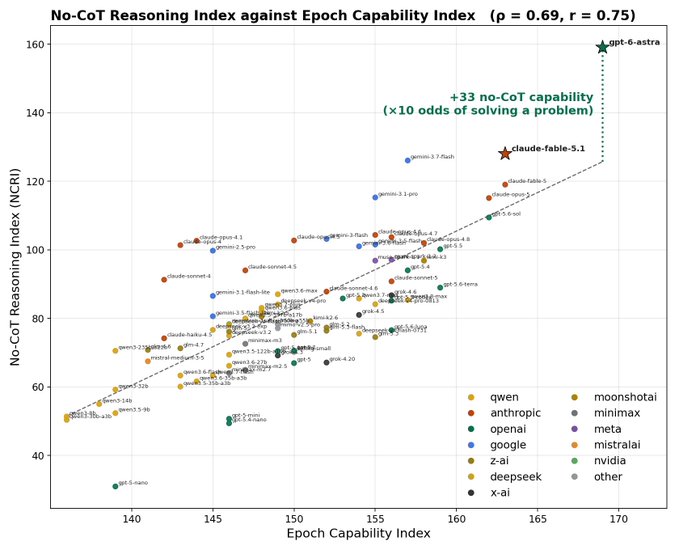
- The OpenAI architecture leak provides no useful additional information on the monitorability of GPT-6 Astra if you know Astra’s no-Chain-of-Thought capabilities. And the latter is public information!
 1 likes · 0 reposts
- this really updates me in the direction of "unforced error due to different arms of a large org being staffed by very different people "1 likes · 0 reposts
- Not sure if I'm parsing you correctly, but - Ryan worked at Anthropic?0 likes · 0 reposts
- yes in general very much so0 likes · 0 reposts
- tbc this is not a 'they should be fired for doing this alone' unless there was an explicit policy against it, and I am in plenty of chats with disappearing messages because others wanted them0 likes · 0 reposts
- People have written papers on doing architecture versions of this and I’m like. Idk man. I think just measuring the capabilities seem a lot more convincing: arxiv.org/abs/2603.09786 (Original graph is from lesswrong.com/posts/eRmzz8J8…)0 likes · 0 reposts
- I would personally learn ~nothing about the monitorability of a model by knowing its architecture, if I already know about its no-CoT capabilities, which is publicly available. no-CoT capabilities basically tells us how much computation the model can do without thinking “out loud.” Like the thing you would want to try to guess based on the architecture is how much opaque reasoning the model can do. But we can just measure the opaque reasoning abilities directly!
 0 likes · 0 reposts
- 0 likes · 0 reposts
 @ryangreenblatt research ·
 @_nathancalvin policy ·
 @evanhub lab ·
 @davidskrueger research ·
 @dkokotajlo research ·
 @peterwildeford policy ·
 @kelseytuoc press ·
 @andrewcurran_ commentary ·
 @hamandcheese policy ·
 @thezvi commentary ·
 @tenobrus commentary ·
 @miles_brundage policy ·
 @tszzl lab ·
 @tim_hua_ research ·