OpenAI and Wiz: AI-found PHP RCE flaws affect ~70% of websites; patch released, NSA advisory issued
Wiz reports frontier models (GPT-5.6 Sol and Gemini 4 Argon) made a decade-old PHP exploit chain practical, enabling unauthenticated RCE and memory disclosure in nearly every PHP version. OpenAI says its Patch the Planet coalition patched it before coordinated disclosure; Greg Brockman says more findings including a Node.js RCE are coming, and the NSA advised PHP users to prepare for updates. Boaz Barak, Nathan Calvin and Dean Ball debate whether AI vulnerability discovery favors defenders while attack automation favors attackers.
All posts · 36, most important first
- OpenAI models helped researchers—operating as part of our Patch the Planet initiative—discover critical security flaws in PHP, an open-source programming language used to run an estimated 70% of websites. Over the past two months, we led a coalition of maintainers, researchers, and security providers to prepare fixes and protections ahead of disclosure. This duration was necessary because the fix was quite intricate and required a major change to the PHP engine. Every site using PHP can now safely upgrade their version to stay secure, in addition to applying mitigations from various security vendors. Due to the severity of these flaws and PHP’s widespread use, we consider this bug to be one of the most impactful vulnerabilities in recent memory. It also marks a new phase, where AI can find security bugs with internet-scale impact. This is an example of the Defender’s Window in action: to our knowledge, frontier AI was able to find this vulnerability ahead of attackers, giving defenders time to prepare. openai.com/index/coordina…1,619 likes · 438 reposts
- AI systems found a working server takeover exploit in PHP, one of the most critical cybersecurity issues in recent memory! - The vulnerability was found using a mix of OpenAI's GPT-5.6 Sol and Google's Gemini 4 Argon, plus human expertise - PHP is the programming language behind ~70% of websites, most notably Wordpress - The bugs sit in PHP itself, so nearly every PHP site is exposed no matter how well its own code is written. Merely running PHP itself is the risk - The vulnerability lets an attacker with no login either run code on a server or read its memory, which can hold passwords, session tokens, API keys, or other secrets - The flaw is from from how PHP cleans up when a request crashes after running out of memory: corrupted state is left behind and the next request can pick it up. An attacker can force that memory crash with a crafted upload, so even a bare page on a vulnerable version can be taken over.Exclusive: AI just found one of the most severe online bugs ever. It puts up to 70% of the world’s websites at risk. on.wsj.com/486iOWG open on X9 likes · 1 reposts
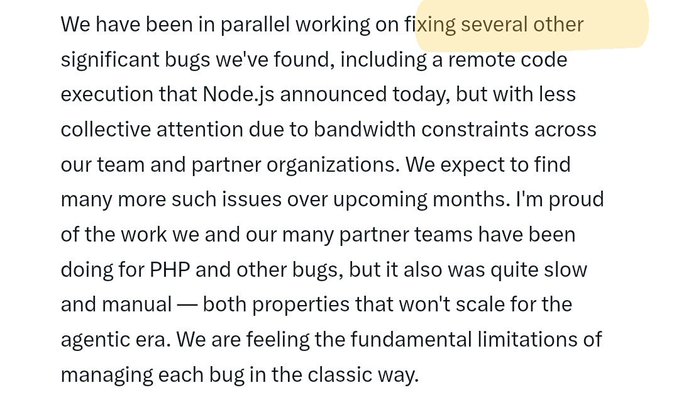
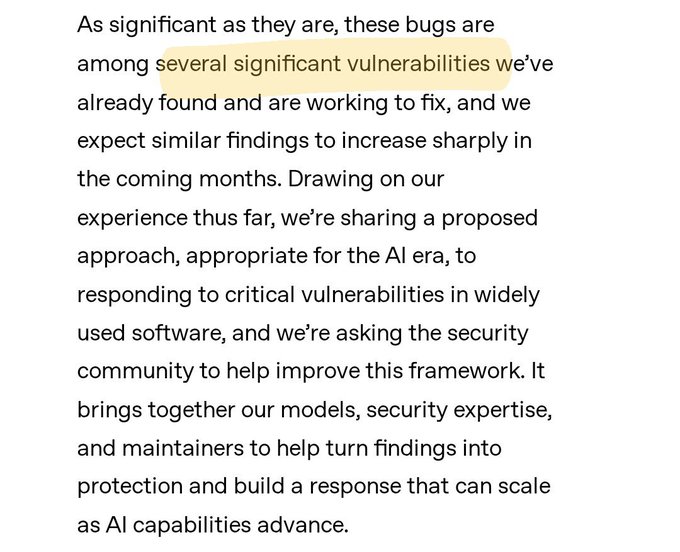
- The AI/cyber risk domain is heating up rapidly. OpenAI researchers and collaborators used Sol to identify critical vulnerabilities in PHP, which is used by ~70% of websites worldwide, using GPT 5.6-Sol. openai.com/index/coordina… Concerningly, these are only some of a number of significant vulnerabilities they've identified, and they're expecting a sharp rise in coming months. "As significant as they are, these bugs are among several significant vulnerabilities we’ve already found and are working to fix, and we expect similar findings to increase sharply in the coming months." This seems like evidence against the claim that AI applied to defense will outpace or keep pace with attack; it seems notable that Sol-5.6 is finding vulnerabilities that Mythos did not find 6 months ago, and suggests there will be even more vulnerabilities to find with future models.0 likes · 0 reposts
- Greg Brockman: 'We have been in parallel working on fixing several other significant bugs we've found, including a remote code execution that Node.js announced today, but with less collective attention due to bandwidth constraints across our team and partner organizations. We expect to find many more such issues over upcoming months.'
 Over the past two months, we have been leading a coalition to mitigate one of the most severe bugs in open source software found in recent memory, php2shell, found as part of our Patch the Planet initiative. https://t.co/rBsz7lrlwo open on X24 likes · 1 reposts
- A day in which a vulnerability is discovered by security researchers using defensive AI is certainly not the "worst day" by any means. But I admit I have huge uncertainty as to how the near future will unfold, and am worried, not so much from novel vulnerability discovery as by attack automation.I don't think "everything is fine," but anyone claiming that php2shell is "the worst day in cybersecurity history" needs to explain why there's more risk here than: Innumerable celebrity vulns and exploit PoCs, Serious protocol bugs in TCP/IP/DNS, Out-of-control worm incidents, Nation-state attacks on economies/critical infrastructure e.g. Russia->Ukraine, Kernel packet-parsing bugs in popular operating systems, The proliferation of AI social engineering tools since 2022, The proliferation of AI hacking tools. If you can't explain why this time is different/worse, with reference to clear technical mechanisms and attacker motivations, you don't have a serious argument.. I also think this kind of alarmism detracts from the genuine fact that we have a looming crisis in security due to AI which we need correct risk models for open on X3 likes · 0 reposts
- yeah I think two are happening at the same time and its confusing: AI helping cybersecurity situation: - 5.6 sol (yay daybreak) discovering this PHP vulnerability that was already there so people can patch it (of course can be worse in short term while lots of systems go unpatched, and also long tail of legacy unpatched systems) AI not helping cybersecurity situation: - lots of AI powered automated cyberattacks (e.g. railway and opencode hacks) I think vulnerability discovery probably on average favors defenders in the medium term. Automating cyber operations will help attackers a lot though (every random community bank or old person is not gonna have AI swarms protecting them against AI augmented spear fishing). Of course the cycle of patching vulnerabilities is becoming a lot harder because of how fast automated cyberattacks are. Also an aside on AI spear fishing in particular - Literally today I had one of those fake tech crunch reporters reach out over DMs and the fake was pretty convincing (thousands of followers, tweets and photos about tech crunch, but when I googled became clear person didn't exist). People who are not used to the idea that people can lie in convincing ways on the internet are going to get exploited over and over again and its gonna be bad (and also generally make it way harder to have good interactions with humans you don't know online).@boazbaraktcs: A day in which a vulnerability is discovered by security researchers using defensive AI is certainly not the "worst day" by any means. But I admit I have huge uncertainty as to how the near future will unfold, and am worried, not so much from novel vulnerability discovery as by attack automation. open on X0 likes · 0 reposts
- I am also optimistic that AI/cyber will be defense-friendly after things stabilize, but before that it will be offense-friendly, which creates a lot of dynamics that are difficult to model: 1. For any existing or new vulnerabilities discovered by governments and other offensive actors, there will be an incentive to exploit them quickly, rather than sit on them quietly, because they will anticipate that the defender will find the vulnerability and patch it much faster than before. 2. The surface area of cyber is very broad, and finding vulnerabilities is different from fixing them, which is also different from fixing them without also introducing new, even subtler security problems into the code. 3. We do not know how high the ceiling for subtle bugs might be. Do there exist vulnerabilities that were simply too hard for humans to find or laborious to exploit? How many vulnerabilities? How long will they persist? We are now getting to the point where we have to reason about systems with quasi-superhuman cognitive performance. This is hard! Counter-intuitive things will happen. 4. There are some threats such as hardware vulnerabilities or new discoveries in cryptography where the offense/defense dynamics could be importantly different from traditional cyber. There was always going to be some tumult as models gained cyber capabilities. This was by far the easiest major novel AI risk to project, in broad terms. It may be true that broad and rapid diffusion is the optimal path forward; that outcome wouldn’t surprise me that much. But it could also be true that, given the offense-favoring dynamics at first and the uncertainties I have described, it’ll be optimal to slow diffusion. And regardless of whether it is optimal to do so, I would expect substantial political pressure to “do something” if the cyber events are sufficiently damaging or disruptive. The optimal outcome is one where we diffuse fast and comprehensively enough to find and fix vulnerabilities while also not causing too much tumult. Maybe we are striking the balance effectively now, as a global industry! I hope so. But I also hope everyone is attentive and ready to update their beliefs/strategies as we gather empirical data. I’m skeptical of anyone who seems confident here in either direction. Near as I can tell, despite a lot of scary potential, nothing truly catastrophic has happened yet (the water is running; the lights are on, no cataclysmic data breaches I am aware of). I hope that continues to be the case. I do agree with the AI risk skeptics that there is a lot of catastrophizing on X about this, and the current attacks, while significant, seem well within the range of things we can bounce back from. If things continue at this level of severity, I feel pretty good about our situation with AI/cyber. But if it gets noticeably worse and seems to be on a trend of getting even more severe, which is my expectation, we could be in for trouble. Maybe society can digest way more cyberattacks than I had apprehended. Maybe “cybersecurity is not very important” as the famous saying/paper goes. I’m very much open to being pleasantly surprised.@_nathancalvin: yeah as others have said, two different trends around AI + cyber are happening at the same time and its confusing: AI helping cybersecurity situation: - 5.6 sol (yay daybreak) discovering this PHP vulnerability that was already there so people can patch it (of course can be worse in short term while lots of systems go unpatched, and also long tail of legacy unpatched systems) AI not helping cybersecurity situation: - lots of AI powered automated cyberattacks (e.g. railway and opencode hacks) Vulnerability discovery probably on average favors defenders in the medium term. Automating cyber operations will help attackers a lot though, and probably enough to overwhelm positive effects on the former (every random community bank or old person is not gonna have AI swarms protecting them against AI swarm attacks). Of course the cycle of patching vulnerabilities is becoming a lot harder because of how fast automated cyberattacks are. Also an aside on AI spear fishing in particular - Literally today I had one of those fake tech crunch reporters reach out over DMs and the fake was pretty convincing (thousands of followers, tweets and photos about tech crunch, but when I googled became clear person didn't exist). People who are not used to the idea that people can lie in convincing ways on the internet are going to get exploited over and over again and its gonna be bad (and also generally make it way harder to have good interactions with humans you don't know online). open on X11 likes · 3 reposts
- >these models will make us all safer by finding long lurking issues. Interested to explore the "make us all safer" framing with you. Is there a threshold at which the increase in the volume of discovered vulns is clearly counterfactually enabled by AI, and the total volume/pace has increased enough beyond a pre-AI baseline, that you'd no longer describe models as a class as "making us all safer"? As an analogy, imagine that AI systems helped us invent a method that could show an attacker every door that was unlocked anywhere in a city. Of course, people could still lock their doors, and AI might even help them make tools that remind them to lock their doors. But, is there a point at which it becomes simpler to describe the effect that AI would be on society in this hypothetical domain (door locking/personal security) as "making the situation more precarious and chaotic" rather than "making us safe"? (obviously, analogies can mislead, I don't claim this is a perfect analogy. I'm also not sure what the answer to my question is, I'm just thinking out loud)3 likes · 0 reposts
- i mean it's like an 8. this isn't literally the internet shutting down, this is pretty much what was obvious as soon as mythos was announced. a huge fraction of *websites* use PHP, but most services you use day to day don't, or if they do are run by extremely competent big tech companies who will have already patched this. google is fine, meta is fine, etc etc. but smaller businesses, hell fortune 500s with less competent tech teams, your credit unions and not maximally large banks, basically everything in the medium to long tail, is incredibly exposed. probably the 2 months openai bought before disclosure was enough to bite out a solid chunk of the middle of the tail... but definitely not all of it. if you have any kind of sensitive info or relationships with said services... well expect them to be hacked, expect it to be dumped. they don't have the expertise or ability or will to fix this quickly, ai or no ai. if you had some old random website you liked visiting that looks like it hasnt been updated since 2014, solid shot the server gets taken over and it either starts mining monero on your browser or just totally shut down. its all manageable at the end of the day. but manageable and managed arent the same thing3 likes · 1 reposts
- unfortunately just saying it exists is very likely enough to result in people finding it within hours4 likes · 0 reposts
- If you are wondering whether your website is affected, we have packaged a Codex skill to help check. Point your Codex at this repo to guide you through it: github.com/openai/php2she…@openai: OpenAI models helped researchers—operating as part of our Patch the Planet initiative—discover critical security flaws in PHP, an open-source programming language used to run an estimated 70% of websites. Over the past two months, we led a coalition of maintainers, researchers, and security providers to prepare fixes and protections ahead of disclosure. This duration was necessary because the fix was quite intricate and required a major change to the PHP engine. Every site using PHP can now safely upgrade their version to stay secure, in addition to applying mitigations from various security vendors. Due to the severity of these flaws and PHP’s widespread use, we consider this bug to be one of the most impactful vulnerabilities in recent memory. It also marks a new phase, where AI can find security bugs with internet-scale impact. This is an example of the Defender’s Window in action: to our knowledge, frontier AI was able to find this vulnerability ahead of attackers, giving defenders time to prepare. openai.com/index/coordina… open on X1,409 likes · 268 reposts
- OpenAI says the PHP security flaw (found with GPT-5.6 Sol) is the tip of the iceberg, and they have several more discoveries to announce.
 @openai: OpenAI models helped researchers—operating as part of our Patch the Planet initiative—discover critical security flaws in PHP, an open-source programming language used to run an estimated 70% of websites. Over the past two months, we led a coalition of maintainers, researchers, and security providers to prepare fixes and protections ahead of disclosure. This duration was necessary because the fix was quite intricate and required a major change to the PHP engine. Every site using PHP can now safely upgrade their version to stay secure, in addition to applying mitigations from various security vendors. Due to the severity of these flaws and PHP’s widespread use, we consider this bug to be one of the most impactful vulnerabilities in recent memory. It also marks a new phase, where AI can find security bugs with internet-scale impact. This is an example of the Defender’s Window in action: to our knowledge, frontier AI was able to find this vulnerability ahead of attackers, giving defenders time to prepare. openai.com/index/coordina… open on X29 likes · 4 reposts
- if ur in using cloud services to store ur critical information, pivot to having local backups25 likes · 3 reposts
- alt version of this i should have thought of months ago: this is also a really bad time to keep your money in small regional banks or credit unions. sure, theyre probably insured and you'll get it back eventually. but eventually can be incredibly fucking disruptive to your life, and any org without a massive well staffed cyber team is getting absolutely completely fucked. if you have even the mildest suspicion your bank uses PHP, get the fuck out today.@tenobrus: epistemic status: loosely held speculation this is probably a pretty bad time to be holding very much money in crypto wallets and especially smart contracts. mythos level cybersecurity capabilities will probably proliferate relatively nearterm, and zerodays on that scale means countless smart contracts hacked and countless keys leaked. i think it's pretty plausible the actual cores of Bitcoin and Ethereum remain stable, but unless you were very careful about setting up a hardware wallet and never exposed your keys you might already be in danger, and even then there's countless attacks possible that can drain everything without getting your keys. and if your crypto is gone you have no recourse. even if banks get massively hacked there's a pretty sold chance everything gets reversed, or insurance pays out. you have far more protection against system failures. now i will say if you give it a 6-12 month period of mythos level *hardening* on Ethereum + various specific wallets and smart contracts, it's likely they're also the most viable long term path we have to genuinely secure financial systems. banks will always be subject to social engineering and supply chain attacks in ways crypto at least can be more exempt from, and even if things can be rolled back it's a crazy inconvenience . but self custody might be the wrong move for a while unless you're incredibly careful and paranoid . the threat models have changed open on X22 likes · 0 reposts
- i sure hope these are short-term growing pains. but i think things are going to get a shitload worse before they get any better.@tenobrus: people often say things like "sure ai cyberoffence is dangerous but it will be countered by ai cyberdefence, there aren't infinite bugs in code". i think this whole situation is a pretty great example of why i don't find that very comforting. sure maybe eventually we converge on a perfect beautiful lean-checked universal stack. but in the meantime, the labs themselves, entities with infinite token budgets, no refusals, and models beyond anything available, cannot secure their own systems against these models! not even against sustained malicious attack, even just against internal eval runs. and from my perspective the reason is that *the attack surface is very very large*. a model trying to jailbreak its sandbox only has to find one bug, one misconfig, one assumption that doesn't hold. and no matter how incredibly carefully hardened your own code is.... how hardened is the code you rely on? the code it relies on? the random scripts and infra in between that you don't even really think of as code? what about the interfaces between different pieces of software that allow interactions you didn't consider which don't technically constitute a bug or exploit in either alone? if you give GPT 6 infinite token budget and ask it to secure OpenAI it will certainly do an incredible amount of high quality defensive work. i'm sure it's capable of red-teaming and finding these very exploits. but i don't really believe we're even close to the point where that iterative defense process will *converge*, and even moderately quickly reach a point of safety. there's no law that says finding an exploit makes it easy to fix. it's entirely possible it has massive performance implications, or hell product implications, or just involves getting a bunch of buy-in from an uncooperative team, or means doing major re-architecting and trading off against other priorities, or means you suddenly need to be using vendored patched versions of every single package because no one is upstreaming fixes anywhere near fast enough and so also suddenly can no longer properly pull other people's fixes. i'm sure we will, eventually, figure out how to run a stable internet. but a stable equilibrium on the horizon says basically fucking nothing about how the next few years are gonna go open on X17 likes · 0 reposts
- 👍13 likes · 0 reposts
- What a wild day. We have a lot of work to do to get through this llm transition. But still, feels like the AI world will get crazier and scarier before it gets better. I hope I'm wrong, but my current emotion is something like... "gulp."10 likes · 0 reposts
- Rare NSA post:Effective Immediately, all organizations using PHP for their systems are advised to be prepared for an update addressing two critical vulnerabilities. PHP is widely used for web applications. These vulnerabilities often provide a direct path to the server's file system or database. If an immediate update is not feasible, it is recommend that organizations take the system offline until it can be fully mitigated. NSA will follow up shortly with more specific guidance. open on X10 likes · 0 reposts
- just texted my parents to tell them to get out of the credit union they've been using for 20 years7 likes · 0 reposts
- From OAI:Largest credit goes to @lcfr_hax for the earliest recent discovery of the bug class. This underlying engine issue was so wide it invited a lot of parallel discovery. As we coordinated our findings the scope of the problem continued to expand! open on X5 likes · 0 reposts
- yeah as others have said, two different trends around AI + cyber are happening at the same time and its confusing: AI helping cybersecurity situation: - 5.6 sol (yay daybreak) discovering this PHP vulnerability that was already there so people can patch it (of course can be worse in short term while lots of systems go unpatched, and also long tail of legacy unpatched systems) AI not helping cybersecurity situation: - lots of AI powered automated cyberattacks (e.g. railway and opencode hacks) Vulnerability discovery probably on average favors defenders in the medium term. Automating cyber operations will help attackers a lot though, and probably enough to overwhelm positive effects on the former (every random community bank or old person is not gonna have AI swarms protecting them against AI swarm attacks). Of course the cycle of patching vulnerabilities is becoming a lot harder because of how fast automated cyberattacks are. Also an aside on AI spear fishing in particular - Literally today I had one of those fake tech crunch reporters reach out over DMs and the fake was pretty convincing (thousands of followers, tweets and photos about tech crunch, but when I googled became clear person didn't exist). People who are not used to the idea that people can lie in convincing ways on the internet are going to get exploited over and over again and its gonna be bad (and also generally make it way harder to have good interactions with humans you don't know online).@boazbaraktcs: A day in which a vulnerability is discovered by security researchers using defensive AI is certainly not the "worst day" by any means. But I admit I have huge uncertainty as to how the near future will unfold, and am worried, not so much from novel vulnerability discovery as by attack automation. open on X4 likes · 2 reposts
- yeah i don't know that this is a "literally today at all costs" thing, more just "get to it soon". the specific vuln here is serverside, attackers can gain full control of a host OS via crafted requests, so less stealing your passwords and more owning the bank.4 likes · 0 reposts
- separately the weak root certs issue also disclosed yesterday could leave u open to MitM... but only if ur not using a modern device w auto updates on3 likes · 0 reposts
- *disclosed* vulnerabilities2 likes · 0 reposts
- OpenAI:@openai: If you are wondering whether your website is affected, we have packaged a Codex skill to help check. Point your Codex at this repo to guide you through it: github.com/openai/php2she… open on X2 likes · 0 reposts
 🚨DEFCON 1🚨 In a few hours, a critical vulnerability that affects ~70% of web sites will be disclosed. It allows an attacker to upload and execute arbitrary code. It's probably best if you stop browsing the internet for the rest of the week. open on X2 likes · 0 reposts
- Context on what "massive" means
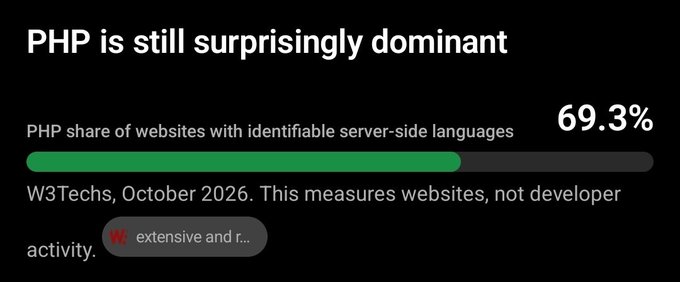 🚨 A MASSIVE internet security emergency is unfolding right now. 🚨 Two CRITICAL vulnerabilities have been discovered in PHP, potentially putting millions of websites at risk. → NEARLY 70% of websites with a known server-side language run PHP. The potential scale is ENORMOUS. → TWO CRITICAL security flaws have been confirmed, each scoring 9.2/10 in severity. → Attackers could potentially take control of vulnerable servers remotely, without authentication. → Reports suggest PHP versions dating back to 2004 could be affected. The exact scope is still unconfirmed. → EMERGENCY PATCHES are scheduled for TOMORROW at 10 AM ET. Website owners are being urged to prepare immediately. → Europe's CERT-EU is warning organizations to patch ASAP or consider TAKING EXPOSED APPLICATIONS OFFLINE if they cannot be secured. → WordPress, Magento, Laravel and potentially millions of other PHP-powered websites could be at risk. → Once patches go public, hackers could reverse-engineer them and race to attack servers that haven't updated. The vulnerabilities are CONFIRMED. The full technical details remain secret. Tomorrow, the race between hackers and defenders begins. This could get ugly. FAST. open on X2 likes · 1 reposts
- the discovery of the php vuln is a good example of the latter position—controlled access to the most serious capabilities given to trusted defenders. but we are seeing much much more than that unfold.1 likes · 0 reposts
- As an analogy I originally was going to use: > imagine that AI systems helped us invent a new and far more deadly class of weapon that could easily take out whole cities while also being easy to hide. Imagine that AI systems also help us come up with some defenses against this new class of weapon, even roughly at the same pace. I think the problem with this analogy is that with vulns the problem sort of "already exists", and AI tools aren't making them worse, they're just uncovering what was already there.1 likes · 0 reposts
- NSA:Effective Immediately, all organizations using PHP for their systems are advised to be prepared for an update addressing two critical vulnerabilities. PHP is widely used for web applications. These vulnerabilities often provide a direct path to the server's file system or database. If an immediate update is not feasible, it is recommend that organizations take the system offline until it can be fully mitigated. NSA will follow up shortly with more specific guidance. open on X1 likes · 0 reposts
- yeah I think two are happening at the same time and its confusing: AI helping cybersecurity situation: - 5.6 sol (yay daybreak) discovering this PHP vulnerability that was already there so people can patch it (of course can be worse in short term while lots of systems go unpatched, and also long tail of legacy unpatched systems) AI not helping cybersecurity situation: - lots of AI powered automated cyberattacks (e.g. railway and opencode hacks) I think vulnerability discovery probably on average favors defenders in the medium term. Automating cyber operations will help attackers a lot though (every random community bank or old person is not gonna have AI swarms protecting them against AI swarm attacks). Of course the cycle of patching vulnerabilities is becoming a lot harder because of how fast automated cyberattacks are. Also an aside on AI spear fishing in particular - Literally today I had one of those fake tech crunch reporters reach out over DMs and the fake was pretty convincing (thousands of followers, tweets and photos about tech crunch, but when I googled became clear person didn't exist). People who are not used to the idea that people can lie in convincing ways on the internet are going to get exploited over and over again and its gonna be bad (and also generally make it way harder to have good interactions with humans you don't know online).@boazbaraktcs: A day in which a vulnerability is discovered by security researchers using defensive AI is certainly not the "worst day" by any means. But I admit I have huge uncertainty as to how the near future will unfold, and am worried, not so much from novel vulnerability discovery as by attack automation. open on X0 likes · 0 reposts
- Is this php related?0 likes · 0 reposts
- Because of The Hackening I have Claude Code running updates to everything on my computer and it's the next day and I'm still getting randomly interrupted for periodic approvals.0 likes · 0 reposts
- i mean... most of these vulns were in fact found by ppl doing exactly this?0 likes · 0 reposts
- This if anything exceeds what I thought would be happening this early in the timeline by a large marginThe day the internet broke, and most of it is too old to fix. open on X0 likes · 0 reposts
- SOL*The day the internet broke, and most of it is too old to fix. open on X0 likes · 0 reposts
 @openai org ·
 @peterwildeford policy ·
 @s_oheigeartaigh policy ·
 @andrewcurran_ commentary ·
 @boazbaraktcs lab ·
 @_nathancalvin policy ·
 @deanwball policy ·
 @chrispainteryup policy ·
 @tenobrus commentary ·
 @natolambert research ·
 @hamandcheese policy ·
 @thezvi commentary ·