Stephen Casper-led Belfer Center paper gives pre-mortem of a major AI-enabled terrorism event with 9 predictions
A Belfer Center paper led by KamacheeMax with Stephen Casper argues a major AI-enabled bio, chem, or cyber terrorism event could come as early as 2027-2028 and makes 9 falsifiable predictions. Central claim: it would trace to a closed-weight model without state-of-the-art safeguards or an open-weight model whose safeguards didn't survive tampering. Coauthors include Jordi Weinstock, Antonia Juelich, Jonas Raedler, and Elise Racine; a Harvard Gazette interview accompanies the release.
All posts · 11, most important first
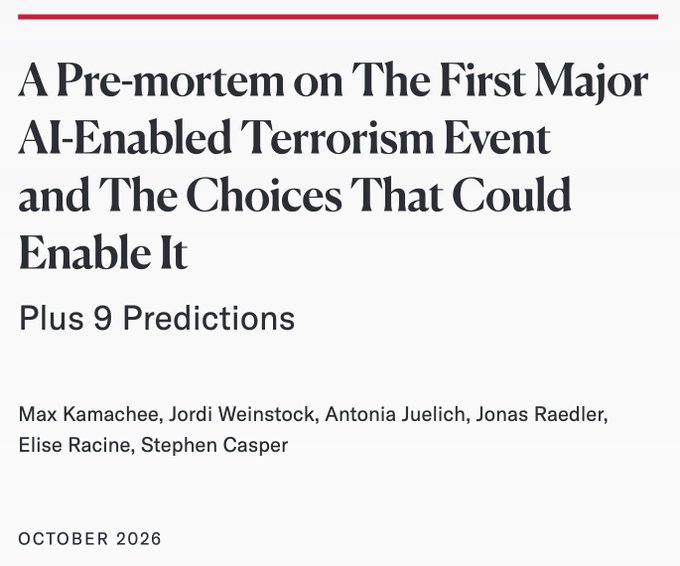
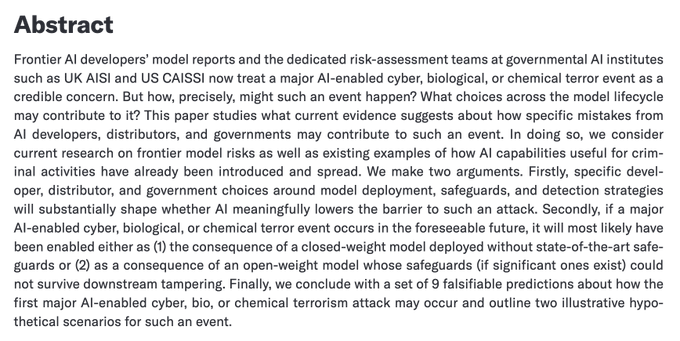
- 🚨New paper (possibly the most important one I have written yet). We think that as early as 2027 or 2028, there might be a major AI-enabled terrorism event. We conducted a pre-mortem, made 9 falsifiable predictions, and wrote 2 concrete scenarios. Led by @KamacheeMax.
 19 likes · 8 reposts
- This leads us to our central prediction: Such an event will trace to either a closed-weight model deployed without state-of-the-art safeguards or an open-weight model.1 likes · 0 reposts
- We hope that this paper can help ground serious discussions about mitigating AI-enabled terrorism risk. Paper (coming to arXiv/SSRN soon): belfercenter.org/research-analy…1 likes · 0 reposts
- From an AI safety science perspective, this paper considers how (1) these harmful capabilities would be developed, (2) they would be deployed, (3) the dangerous capability would be elicited, (4) safeguards would fail, and (5) detection would fail.1 likes · 0 reposts
- Finally, we describe two grounded, realistic illustrative scenarios for how such an attack might occur, involving: 1. A non-state group, a closed-weight model, and a biological attack 2. A state-sponsored group, an open-weight model, and a cyberattack1 likes · 0 reposts
- And a piece by the Harvard Gazette: news.harvard.edu/gazette/story/…3 likes · 0 reposts
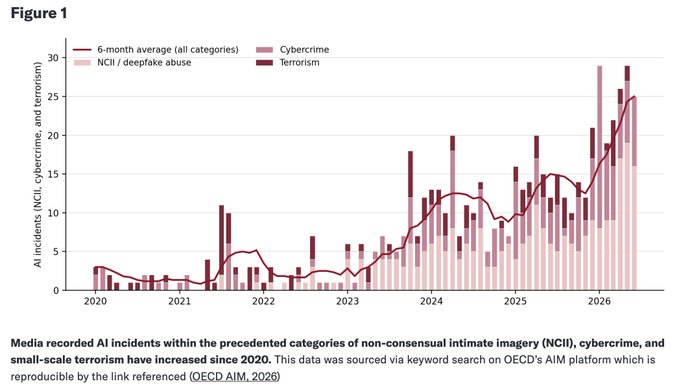
- The threat isn't hypothetical. There have already been a number of violent and deadly incidents involving small-scale terror and criminal misuse of AI. Frontier AI companies and world governments treat the threat of a bio/chem/cyber attack enabled by AI as a credible concern.
 2 likes · 1 reposts
- We also look at how harmful capabilities have proliferated and been misused in the past several years, involving (1) non-consensual AI nudification, (2) AI-assisted cybercrime, and (3) AI-uplifted small-scale terrorism events.1 likes · 0 reposts
- We make 8 other predictions as well: three about the closed-weight model pathway to harm, three about the open-weight model pathway to harm, and two about either pathway.1 likes · 0 reposts
- Props to @KamacheeMax for the extraordinary talent, persistence, and vision in leading this paper. And a big thanks to other coauthors: Jordi Weinstock, @AntoniaJuelich, Jonas Raedler, & Elise Racine. Work done at @MATSprogram and @BelferCenter at @Kennedy_School.3 likes · 0 reposts
- Think anthrax. Anthrax outbreaks typically kill double or triple digits numbers of people.0 likes · 0 reposts
 @stephenlcasper research ·