Anthropic: Claude Mythos 5 designs quantum circuits improving on best published ones
Anthropic reports that Claude Mythos 5, given plain-language specs and an automated evaluator, designed quantum circuits that beat the best published ones, sometimes by an order of magnitude or more. The work, led by Andi Gu with mentors at Anthropic, Harvard, and QuEra, covered eight circuits for chemistry, optimization, physics, and number theory, working largely autonomously. Anthropic says such gains cut the quantum resources needed for useful algorithms, which could bring practical quantum computers sooner — an AI-accelerated-R&D development relevant to timeline considerations.
All posts · 4, most important first
- New from our STEM Fellows Program: Designing more efficient quantum circuits with Claude. Given plain-language instructions, Claude Mythos 5 designed quantum circuits that improve on the best published ones, sometimes by an order of magnitude or more. More efficient circuits reduce the resources needed by quantum algorithms, which could bring quantum computing applications in chemistry and materials science within reach sooner. Read more: anthropic.com/research/desig…496 likes · 62 reposts
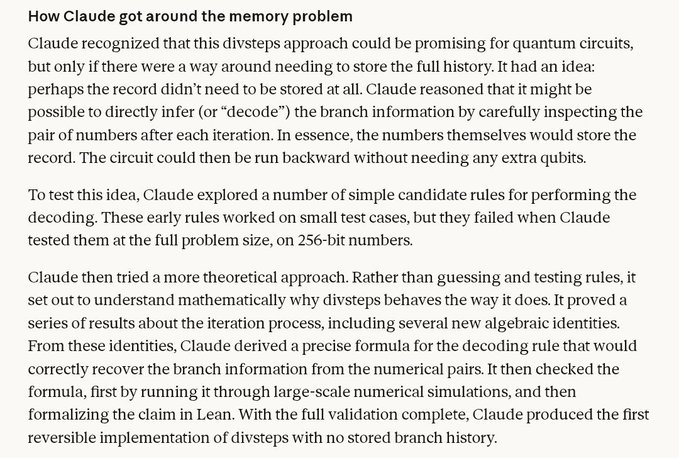
- 'Claude recognized that this divsteps approach could be promising for quantum circuits, but only if there were a way around needing to store the full history. It had an idea: perhaps the record didn’t need to be stored at all. Claude reasoned that it might be possible to directly infer (or “decode”) the branch information by carefully inspecting the pair of numbers after each iteration. In essence, the numbers themselves would store the record. The circuit could then be run backward without needing any extra qubits. To test this idea, Claude explored a number of simple candidate rules for performing the decoding. These early rules worked on small test cases, but they failed when Claude tested them at the full problem size, on 256-bit numbers. Claude then tried a more theoretical approach. Rather than guessing and testing rules, it set out to understand mathematically why divsteps behaves the way it does. It proved a series of results about the iteration process, including several new algebraic identities. From these identities, Claude derived a precise formula for the decoding rule that would correctly recover the branch information from the numerical pairs. It then checked the formula, first by running it through large-scale numerical simulations, and then formalizing the claim in Lean. With the full validation complete, Claude produced the first reversible implementation of divsteps with no stored branch history.'
 0 likes · 0 reposts
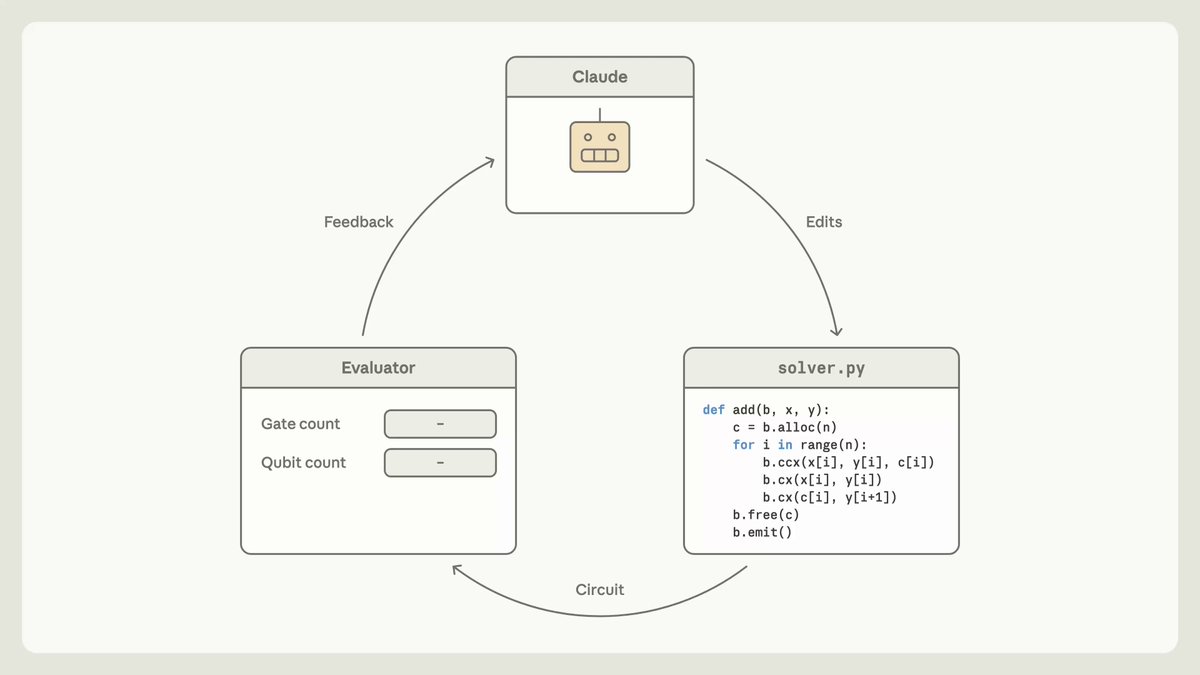
 - Quoting from the blog: 'Claude has proven particularly adept at optimizing classical algorithms, so we wanted to see whether it could do the same for quantum algorithms if it were given only a plain-language description of what each circuit must compute. Claude is unusually well suited to this task, for several reasons. First, quantum algorithms are implemented as quantum circuits. These are composed of sequences of gates, like the Toffoli gates mentioned above. Importantly, these circuits can be described in code, so we can make use of Claude’s coding capabilities to write, run, and revise circuit designs as ordinary programs. Second, the (fairly common) class of quantum algorithms we were most interested in optimizing can be tested efficiently for correctness, as each input gives one definite output that an ordinary computer can check. This means we could have an external evaluator program validate Claude’s proposals. Finally, we can give Claude a clear, objective score to improve: the number of qubits used, multiplied by the number of gates, which serves as a proxy for how long the circuit would take to run. We found that Claude Mythos 5 could successfully work in a closed loop, proposing a circuit design, receiving feedback and a score from the evaluator program, and using that feedback to improve its next attempt, with no human input between rounds. Across eight computational primitives—the basic routines that larger quantum algorithms are built from—for chemistry, optimization, quantum simulation, number theory, and numerical computing, Claude discovered novel designs that used both fewer qubits and fewer gates than the best previously published algorithms.'@anthropicai: New from our STEM Fellows Program: Designing more efficient quantum circuits with Claude. Given plain-language instructions, Claude Mythos 5 designed quantum circuits that improve on the best published ones, sometimes by an order of magnitude or more. More efficient circuits reduce the resources needed by quantum algorithms, which could bring quantum computing applications in chemistry and materials science within reach sooner. Read more: anthropic.com/research/desig… open on X12 likes · 0 reposts
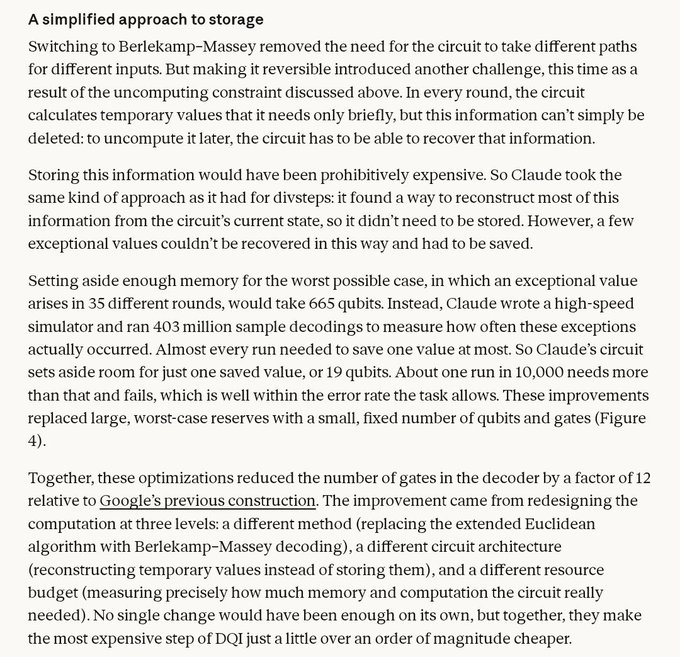
- 'Together, these optimizations reduced the number of gates in the decoder by a factor of 12 relative to Google’s previous construction. The improvement came from redesigning the computation at three levels: a different method (replacing the extended Euclidean algorithm with Berlekamp–Massey decoding), a different circuit architecture (reconstructing temporary values instead of storing them), and a different resource budget (measuring precisely how much memory and computation the circuit really needed). No single change would have been enough on its own, but together, they make the most expensive step of DQI just a little over an order of magnitude cheaper.'
 6 likes · 0 reposts
 @anthropicai org ·
  @andrewcurran_ commentary ·